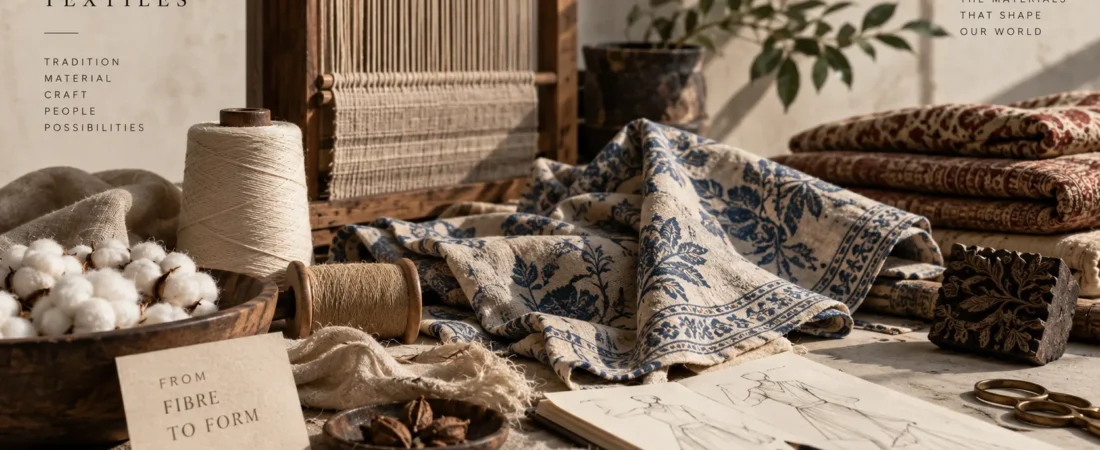
Indian textiles have never been defined by appearance alone.
Behind a printed surface, an embroidered motif or a beautifully draped garment lies a much deeper system of knowledge — one built through fibre, yarn, weaving, dyeing, printing, embellishment and generations of material practice.
To understand Indian textiles is therefore to look beyond decoration.
It is to understand how a material is constructed, how it behaves and how that behaviour can influence design.
For contemporary fashion, this knowledge remains highly relevant. Traditional textile practices can provide designers with not only visual references, but also new ways of thinking about surface, structure, movement and the relationship between material and body.
1. Fiber: Where the Material Begins
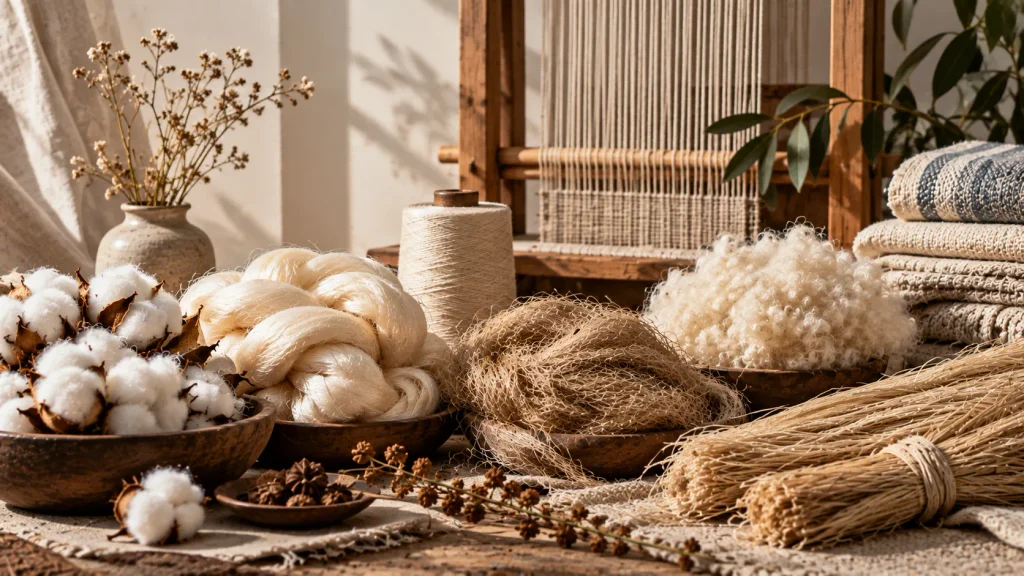
Every textile begins with a fibre.
The characteristics of that fibre influence many of the qualities that eventually define the finished fabric — its softness, strength, weight, absorbency, lustre and ability to hold or release form.
Cotton, silk, linen and other natural fibres each respond differently to processing and construction. Manufactured and regenerated fibres introduce another range of possibilities.
But fibre alone does not determine the final character of a textile.
The journey from fibre to fabric is what creates its identity.
The same fibre can produce remarkably different results depending on how it is spun, woven, finished or combined with another material.
This makes textile development a process of transformation rather than simple material selection.
2. Yarn: Creating Possibility Through Structure
Once fibre becomes yarn, another layer of design begins.
Yarn thickness, twist, texture and composition can influence the final appearance and behaviour of the fabric.
A finer yarn can create a delicate surface.
A heavier yarn can create greater visual presence.
Different yarn structures can produce variations in texture and density.
This is where the relationship between material and construction begins to become visible.
The designer is no longer simply looking at colour or pattern.
The designer is beginning to understand what the textile is made of and how that construction will behave.
3. Weave: The Hidden Architecture
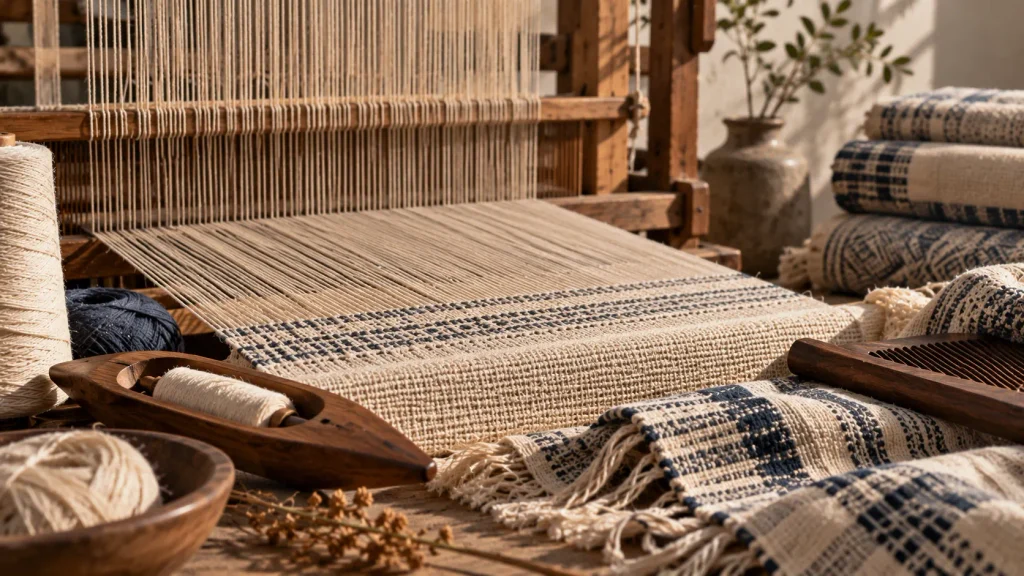
The weave is one of the fundamental structures of a woven textile.
At its simplest level, weaving brings together warp and weft.
But within that basic relationship exists an enormous range of possibilities.
Changes in yarn, density, tension and weave structure can affect:
- surface texture
- weight
- opacity
- flexibility
- strength
- drape
- visual depth
This is why two fabrics with similar colours can behave completely differently when made with different structures.
The surface that we see is only one part of the textile.
The structure beneath it determines much of what the fabric can become.
4. Surface: When Textile Becomes Visual Language
Indian textile traditions demonstrate an extraordinary diversity of surface development.
Printing, embroidery, dyeing, weaving and other techniques can transform a simple textile into something visually distinctive.
But surface should not be understood only as decoration.
It can influence perception, movement and proportion.
A heavily worked surface can add visual weight.
A restrained texture can create subtle depth.
A repeated pattern can alter how the eye reads the body.
A textile with irregular hand-crafted variation can communicate something fundamentally different from a perfectly uniform industrial surface.
The surface therefore becomes another language through which the material communicates.
5. Craft Knowledge and the Human Hand
One of the defining characteristics of many Indian textile traditions is the relationship between material and human skill.
Craft is not simply the application of decoration.
It can involve an understanding of:
- material preparation
- tools
- tension
- repetition
- technique
- timing
- finishing
- local material behaviour
This accumulated knowledge is difficult to separate from the textile itself.
A technique carries a history of making.
A textile can therefore contain both a physical structure and a cultural memory.
For contemporary designers, the challenge is not necessarily to reproduce historical textiles exactly.
It can be to understand the principles behind them and consider how that knowledge might inform new forms.
6. From Traditional Textile to Contemporary Silhouette
The transition from textile to fashion is where material research becomes design.
A textile does not exist independently from the form in which it is used.
A soft, fluid fabric may encourage draping.
A fabric with greater body may support a more architectural silhouette.
A textured surface may become the defining element of an otherwise simple garment.
The designer therefore has to understand both sides of the relationship:
What is the textile?
and
What does the textile want to become?
This is where textile knowledge becomes part of silhouette development.
7. Drape as Material Behaviour
Drape is one of the clearest ways to observe the relationship between textile and body.
Place a fabric on a flat surface and it appears static.
Place that same fabric on a moving body and its character changes.
It folds.
It stretches.
It gathers.
It releases.
It catches light differently.
The body becomes part of the textile’s visual environment.
For this reason, drape should not simply be considered an aesthetic quality.
It is a form of material behaviour.
Understanding that behaviour allows a designer to create silhouettes that work with the textile rather than forcing the textile into an unsuitable structure.
8. Textile Research as Design Research
Textile research should not be limited to collecting beautiful fabrics.
It can involve asking deeper questions:
Where does the material come from?
How is it constructed?
How does it behave?
What techniques have shaped it?
What happens when the material is altered?
How can its qualities be translated into a contemporary garment?
These questions shift textile development from sourcing toward investigation.
The fabric becomes something to study rather than simply something to purchase.
9. The Contemporary Relevance of Indian Textile Knowledge
The future of Indian textiles does not necessarily depend on choosing between tradition and modernity.
There is another possibility:
using traditional knowledge as a foundation for contemporary design.
A traditional technique can inform a modern silhouette.
A familiar textile can be used in an unfamiliar proportion.
A historic surface technique can be interpreted through a restrained contemporary palette.
A material developed through established knowledge can become part of a completely new design language.
The value lies not only in preserving the visible appearance of tradition, but in understanding the knowledge embedded within it.
10. From Fibre to Form
The journey of a textile can therefore be understood as a sequence:
Fibre
↓
Yarn
↓
Structure
↓
Surface
↓
Material Behaviour
↓
Silhouette
↓
Garment
At every stage, another design decision becomes possible.
The finished garment is simply the final expression of a much longer material process.
This is why textile research has such an important role in fashion.
The fabric is not the last step before the garment.
It is one of the first steps toward defining what the garment can become.
Conclusion
Indian textile knowledge represents an extensive vocabulary of material, construction and craft.
Its importance for contemporary fashion lies not only in its visual richness, but in the intelligence contained within its making.
To study the textile is to study structure.
To understand structure is to understand behaviour.
And to understand behaviour is to create more informed relationships between material, silhouette and wearer.
The future of textile-led fashion may therefore depend less on simply looking back at tradition and more on understanding it deeply enough to move forward.
From fibre to form, the material carries the beginning of the design.